
AI in NH
A data center is being considered for southeastern NH.

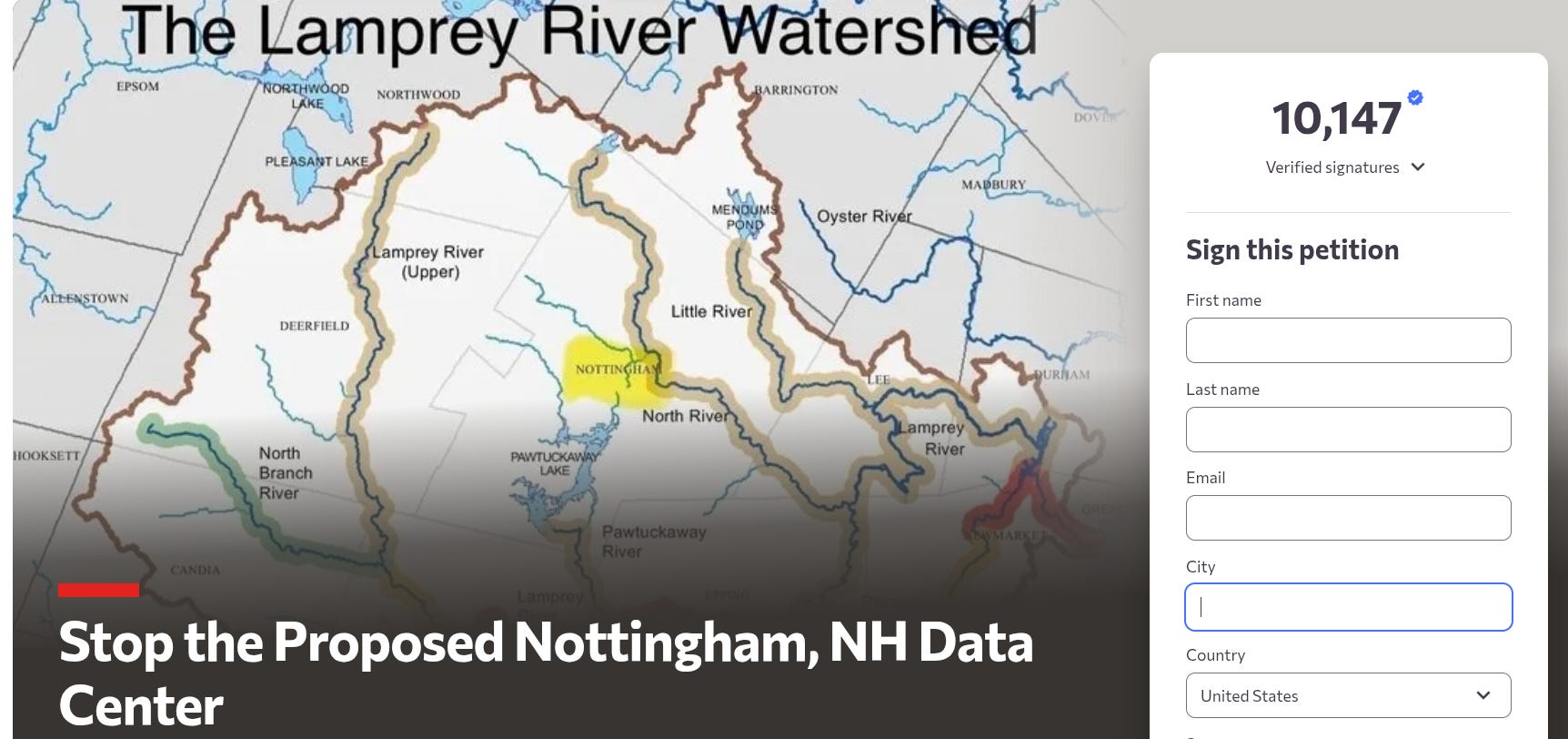
The Nottingham Planning Board in southeastern NH will begin its consideration of an AI data center tonight (May 27th) at 6:30 p.m. The meeting was originally scheduled for the Nottingham Town Hall. It has now been moved to the gym at Nottingham School located at 245 Stage Road. There will be a peaceful protest outside the gym. Residents will testify to the planning board inside the gym.
Here are my thoughts on data centers.
There’s a lot to work out. They shouldn’t be built unless we get the energy, climate and profits worked out first. If it were up to me, I would declare a federal moratorium.
Here’s my FaceBook post on the subject, which was well-received.
Thinking about (not with) AI.
We should push for a federal moratorium until environmental issues can be addressed
AND Congress takes the cap off of Social Security contributions that are now limited to the first $184,500 of income
AND Congress raises the top marginal rate for incomes over $640,600 (individual) and $768,700 (married filing jointly) from 37 percent to at least 50 percent.
A younger person asked if the financial trade-off should include relief for college loans. My answer, “Why not?” How else can we use this moment to restore some semblance of balance between the billionaires and the rest of us?
Data Centers require water.
Water is used to keep servers and other equipment in data centers cool. According to Brookings, a typical data center may use 300,000 gallons of water each day (equivalent to the demands of about 1,000 households). According to scientists at the University of California, Riverside, each 100-word AI prompt is estimated to use roughly one bottle of water (or 519 milliliters). Billions of AI users worldwide enter prompts into Large Language Models (advanced artificial intelligence systems trained on massive datasets to understand, summarize, translate, and generate human-like text) every minute. The direct water needs do not include the indirect needs required for energy generated offsite.
Data center water usage closely parallels energy usage and carbon emissions. As data centers use more energy for their typical data center operations carbon emissions increase. Wetlands help fight climate change by capturing carbon as “carbon sinks.” Destroying wetlands to build a data center is a double whammy.
There are better and worse ways to meet the energy and water needs of data centers. Renewable energy is better than coal fired plants, for example. The same is true for how the cooling water is deployed. Technology likely also will improve to make these centers more efficient. However, we are not there yet.
And, we need to coordinate with other states in the region. Massachusetts has an established data center market. Maine just had a law to impose a moratorium vetoed by Governor Mills.
Is the Lamprey River Watershed, with its wetlands, the best place in this tri-state corner of northern New England to locate a data center? The local planning board in Nottingham is unlikely to know and legally may not be able to care. That’s why federal legislation makes sense.
Find the Point of Leverage
My thinking comes from a moment when I was on the NH Executive Council. The Council was 3-2 Democratic at the time. Republican Chris Sununu was the governor. COVID was in full swing and the federal government started to send financial help to states. Governor Sununu decided that he alone would decide how to deploy the federal funds and he would give the Executive Council, which was designed to be a check on the powers of a governor, only an after the fact summary.
Every month the Executive Council had to approve the state’s spending warrant. Otherwise, the state could not make most of its expenditures. After Sununu refused to relent on his plan for the federal money, I organized my colleagues, Councilor Deborah Pignatelli and Councilor Mike Cryans, to join me in voting down the state’s spending warrant. (I did this in a month with two Council meeting days, so we wouldn’t hurt the state or the recipients of state monies.) Sununu backed off and gave us full transparency and participation in spending decisions.
My point is that we are at a similar trigger point with AI. Businesses and the wealthiest people in our country are committed to AI. They need data centers.We need to leverage the moment and Congress should help by adopting a moratorium on building data centers.
We had a data center bill in Commerce Committee in the NH House. I do not believe that the bill sponsors understood the repercussions of building these centers. We need to involve experts and stakeholders before putting legislation together.
Systems like this require less engineering, don't use water, use less electricity, and are cheaper to own, operate and maintain, throughout their lifetime.
Require it, plus reduced tax incentives. Private ventures can pay for their dc's without public money.
https://www.vertiv.com/en-us/campaigns/data-center-thermal-management/
https://g.co/gemini/share/2012b5487286